Information
We pride ourselves on our adaptability and commitment to excellence in every aspect of our services and movement. Explore Our facts and stats sections and see how we can contribute to you leaving knowledgeable and informed.
FACTS AND STATS
It all began with a simple idea fueled by a deep passion. We pride ourselves on personal attention and dedication to every detail as we are the fuel for this movement to succeed Our approach is rooted in protecting our kids all around the world, ensuring that everything we do reflects our commitment to excellence and being the voice of the voiceless
-
At any given moment, an estimated 50 million people are being victimized in situations of trafficking and exploitation (including forced marriage) worldwide. 25% of these are children. (ILO, 2022)
-
Human trafficking is any situation of exploitation that a person cannot refuse or leave because of threats, violence, coercion, deception, and/or abuse of power. (ILO, 2022) In the case of child sex trafficking, force, fraud, or coercion do not need to be present, and the crime is simply the exchange of any sex act with a child for anything of value.
-
Traffickers exploit vulnerabilities and being a child is an inherent vulnerability. Under US federal law, all children involved in commercial sex are victims of human trafficking. Sadly, only about half of US states have laws that protect sexually exploited children from being prosecuted for prostitution.
-
You’ll often hear about trafficking “hotspots.” The truth is that trafficking occurs wherever there are people. Spikes in reported trafficking may also be influenced by an increased focus in that region on research, training, or an awareness campaign promoting the national hotline.
-
Sex trafficking is not just a “women and girls issue.” About 14% of those in our US survivor care have been boys.
-
Traffickers can look like anyone and don’t fit one stereotype. Love146 has connected with situations of trafficking in which exploiters have been family members, peers, romantic partners, educators, employers, community leaders, and clergy.
-
Sometimes youth continue going to school, living at home, and participating in extracurricular activities – even while they are being trafficked.
-
Often, a “rescue” isn’t the only (or best) way to freedom. Training to recognize & respond appropriately to trafficking, as well as trauma-informed spaces to heal help create pathways for more victims to exit exploitation.
-
Child trafficking is not a new phenomena. Human Trafficking has been happening forever. In 2003 the United Nations introduced the Trafficking Protocol, introducing a universally agreed upon definition of trafficking in persons. (UNODC)
FACTS AND MISCONCEPTIONS EXPLAINED
-
Between one and twenty percent of children (depending on the country)had experienced at least one form of clear online sexual exploitation and abuse in 2021. This suggests that hundreds of thousands of children are being subjected to online sexual exploitation and abuse each year.
-
Over one third of children did not disclose their experience of abuse to anyone; nearly half said it was because they did not know where to go or whom to tell. On average, only 3% of children reported these crimes to law enforcement or a helpline.
-
Children who had experienced online sexual exploitation and abuse were between 40% and 400% more likely to self-harm and to have thoughts of suicide following their experience.
-
In most countries, frontline welfare workers did not feel adequately equipped to support children who experienced this type of crime.
-
Global Scale: An NGO estimated that 300,000 children are sold by traffickers worldwide as slaves.
-
Identified Victims: The United Nations noted 18,000–20,000 children were identified as trafficked globally in 2020, though this is likely a bare minimum due to detection challenges.
-
Regional Trends:
-
Sub-Saharan Africa: Highest number of trafficked children, with forced labor being the most common form.
-
Central America/Caribbean: Most victims are girls, particularly teenagers, trafficked for sexual exploitation.
-
South Asia: Nearly half of all trafficking victims are children, largely exploited for labor or forced marriage.
-
-
European Union Data (2022): Over 10,000 people were identified as trafficked, with 15% being children (about 75% of whom were girls). This represented a 41% increase from 2021.
-
Vulnerability: Children fleeing conflict zones, such as those leaving Ukraine, are highly vulnerable to traffickers.
Approximately 28 per cent of identified victims of trafficking globally are children, UNICEF and the Inter-Agency Coordination Group against Trafficking (ICAT) said today on the eve of the World Day against Trafficking in Persons. Across regions such as Sub-Saharan Africa, Central America and the Caribbean, children account for an even higher proportion of identified trafficking victims, at 64 and 62 per cent respectively.
UNICEF and ICAT believe the number of children who fall victim to trafficking is higher than current data suggests. The reality is that children are infrequently identified as victims of trafficking. Few come forward for fear of their traffickers, lack of information about their options, mistrust of authorities, fear of stigma or the likelihood of being returned without any safeguards and limited material support.
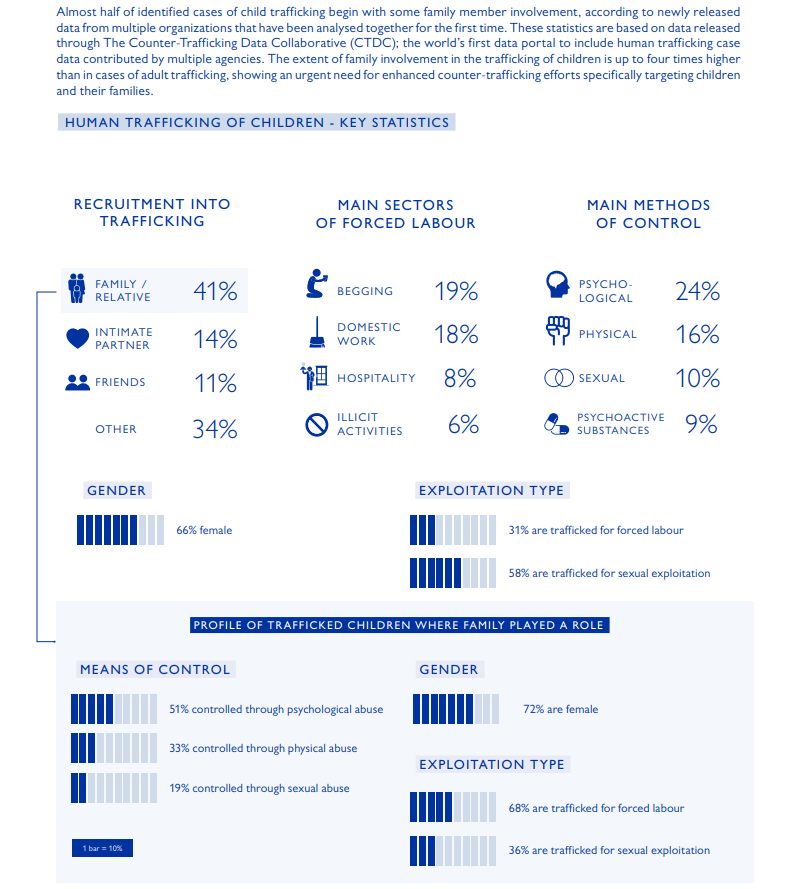
MISCONCEPTIONS ABOUT CHILD TRAFFICKING
Misconception 1: Traffickers are strangers
There is a common misconception that a stranger with bad intentions forces children into trafficking situations. However, child victims are often forced into trafficking situations by people they have a connection with, know, and trust. This can include family members, friends, romantic partners, and employers. In these cases, the trafficker may begin grooming the victim at an early age. Familial trafficking – cases in which trafficking is facilitated directly by family members and/or caregivers – has been found in 44-60 percent of cases within the United States, inclusive of both sex and labor trafficking. In a 2023 study, the Department of Psychiatry and Behavioral Science at Baylor College of Medicine’s Anti-Human Trafficking Program found that out of 39 U.S. familial trafficking cases, the trafficker was a parent (66.7 percent), an uncle or aunt (12.8 percent), or other family members (3.2 percent). Additionally, generational exploitation takes place when there is a pattern of trafficking throughout multiple generations of the family, e.g. “this is what little boys in this family do.” In familial trafficking cases, the average age in which children are initially exploited in trafficking is four years old, while 13 years old is the average age of recruitment for other types of child trafficking. Familial trafficking is unique from other forms of trafficking, due to the relationship between a caregiver and a child. As with most children, victims of familial trafficking are taught to listen to their caregivers and the adults in their lives. Because children’s views of morality and ethics are shaped by adults, particularly before age eight, situations of familial traffickingcan often normalize exploitation. Additionally, the familial relationship may result in children having the desire or need to protect family members from legal consequences. As they seek acceptance, love, and connection, victims can become susceptible to those who gain their trust and love and then subsequently exploit those connections to subject them to trafficking. For this reason, children can also be coerced by friends, romantic partners, or employers.
Misconception 2: Kidnapping is the main form of recruiting children into trafficking
Another belief is that children are commonly kidnapped for both sex and labor trafficking. According to the Human Trafficking Institute’s 2023 report, in the United States, kidnapping of children occurs in only an estimated 0.45 percentof trafficking cases; which means that, while it does happen, it is rare. More commonly, according to the International Office on Migration’s (IOM) Counter-Trafficking Data Collaborative (CTDC), findings indicate family members recruit children into trafficking due to generational exploitation, financial need, or the belief that they are contributing to the family. In addition, CTDC data indicates that intimate partners recruit minors, often with promises of love, belonging, and protection. The CTDC indicates that children are also recruited through individuals considered friends, often with promises of provision of basic needs especially for runaway children or those experiencing homelessness. Additionally, in 2020 there was a 22 percent increase in online solicitation and recruitment of children for both sex and labor trafficking, as well as broader child sexual abuse crimes. These recruitment methods can include promises of employment, material needs, finances, and relationships. Children can also be recruited through the promise of educational opportunities.
Misconception 3: Trafficking only involves sexual exploitation
Child trafficking includes both sex trafficking and forced labor and frequently occurs around the world in sectors such as agriculture, domestic work, construction, fishing, manufacturing, and in competitive sports. In addition, children have been forced to work in begging/peddling, street vending, door-to-door sales, and forced criminality, including drug trafficking. Child trafficking can also include some forms of child marriage, child soldiering, and be present in illegal adoptions for the purpose of exploitation. Of course, children are also exploited in sex trafficking. Child sex trafficking victims may be exploited in many ways and settings, including sexual servitude, some forms of child marriage, sex tourism, escort services, illicit massage businesses, brothels, sextortion, online and in private businesses, such as restaurants, family businesses, bars, or faith-based settings. In addition, child sex trafficking can occur at strip clubs, private residences, private clubs/parties, and on the street.
Misconception 4: Children easily recover from exploitation
While children are overwhelmingly resilient, human trafficking is a severe violation of trust, love, and one’s body. It is a common misconception that once removed from the trafficking situation children recover quickly. Unfortunately, many children who have experienced human trafficking deal with long-term impacts due to their exploitation. Research reveals that 90 percent of trafficking survivors live with long-term mental health conditions. The experience of child trafficking often prevents the forming of secure attachments and feelings of safety throughout the individual’s life. Child trafficking victims frequently live with ongoing trauma symptoms, including complex post-traumatic stress and sleep disorders, such as frequent nightmares or waking in the middle of the night. Additional symptoms may include flashbacks, which can be visual, emotional, or somatic, making the survivor feel as though they are re-experiencing the exploitation. Those victimized are often hypervigilant, with many survivors experiencing depression, anxiety, and dissociation, including dissociative disorders. Survivors also can develop addictions, disordered eating, self-harm, and suicidality. Healing from the trauma of trafficking is a long-term process and requires early, specialized, trauma-informed, developmentally-informed, and culturally responsive services.
Punishments and Accountibility Acts (USA)
18 U.S.C. § 1591 makes it a federal crime to recruit, entice, transport, harbor, obtain, or maintain a minor (under 18) for a commercial sex act—any sexual activity exchanged for something of value (money, goods, favors, or benefits). The law also criminalizes participating in businesses involved in exploiting minors this way. The statute does not require the victim or offender to cross state or international borders, and when the victim is a minor, prosecutors do not need to prove force, fraud, or coercion.
Penalties:
-
Under 14 or if force/fraud/coercion is used: 15 years to life in prison
-
Age 14–17: 10 years to life in prison
-
Obstructing enforcement: up to 20 years in prison
Convicted offenders must also pay restitution to victims for their losses.
Several federal laws under Title 18 criminalize child sexual exploitation and child pornography:
-
18 U.S.C. § 2251 – Producing child pornography
-
18 U.S.C. § 2251A – Buying or selling children for pornography production
-
18 U.S.C. § 2252 & § 2252A – Possessing, receiving, or distributing child pornography
-
18 U.S.C. § 2256 – Legal definitions of child pornography and sexually explicit conduct
-
18 U.S.C. § 2260 – Producing child pornography abroad with intent to bring it into the U.S.
Federal law defines child pornography as any visual depiction of sexually explicit conduct involving a minor (under 18), including photos, videos, or realistic digital images. Even sexually suggestive images of nude minors may qualify. These materials are illegal contraband and not protected by the First Amendment.
The law prohibits the production, distribution, receipt, and possession of child pornography, especially when interstate commerce is involved (such as through the internet, mail, or devices that moved across state lines). Attempting or conspiring to commit these crimes is also illegal.
Penalties:
-
Producing child pornography: 15–30 years in prison (minimum to maximum) for a first offense
-
Transporting/distributing: 5–20 years in prison
-
Aggravating factors (violent content, abuse, or prior offenses) can lead to life imprisonment
Offenders may also face state charges in addition to federal prosecution
18 U.S.C. § 2423(d): Travel with intent to engage in illicit sexual conduct
18 U.S.C. § 2423(c): Engaging in illicit sexual conduct in foreign places
18 U.S.C. § 2423(d): Ancillary Offenses
18 U.S.C. §§ 2251(c) and 2260(a): Production of Child Pornography outside the United States
18 U.S.C. § 1591: Sex Trafficking of children by force, fraud, or coercion
18 U.S.C. § 1596: Additional jurisdiction in certain trafficking offenses